
In the first article of this three-part collection, I’ve introduced you to the notion of the schema and we have explored some of the most important needs that, when unmet, give rise to dysfunctional beliefs: basic safety, connection, autonomy, self-esteem, self-expression and realistic limits.
In today’s feature, we will explore the concept of “schema modes” and maladaptive coping styles. Schema modes are the emotional states and coping responses that emerge at any given point in time, as a reaction to triggering events, when we feel that one of the important needs mentioned before is not being met.1
Coping modes or strategies are sets of behaviours or thoughts which are employed in stressful, unpleasant or threatening situations
Schema modes might be adaptive, in that they allow us to adequately respond to our environments and navigate them to meet our goals.2 They may also be maladaptive or dysfunctional, that is, they may prevent us from participating in different dimensions of our lives in healthy, effective and consistent ways.3 A schema mode is activated in association with a particular schema or coping responses that take control of an individual’s functioning4.
According to Young, Klosko and Weishaar, the main authors of Schema Therapy, “schema modes can be characterized by the degree to which a particular schema-driven state has become dissociated, or cut off, (…) from other aspects of the self“1 (p. 40). Schema modes thus lie at different points of “dissociation” spectrum. If the individual can simultaneously experience different aspects of themselves (i.e., different modes), without rigidly fixating on one, and while maintaining a consistent sense of identity, the level of dissociation is lower. It is normal to shift between different modes or aspects of ourselves. We often call these mood shifts, as when we fluctuate between an angry mood, a sad mood, a detached mood, etc. However, if the dissociation is very strong, individuals may experience what is called a dissociative identity disorder, which is a condition where someone acting in one mode may not even know that other modes exist, and may even have different names, ages, genders, personality traits, memories and functions. Movies like Fight Club and the tv series United States of Tara attempt to portray this sort of disorder.
What modes have been identified so far?
10 Schema modes have been identified, which have been grouped into four categories: Dysfunctional coping modes, Child Modes and Dysfunctional Parent modes, and the Healthy Adult mode. Below is a summary description of each of the modes.
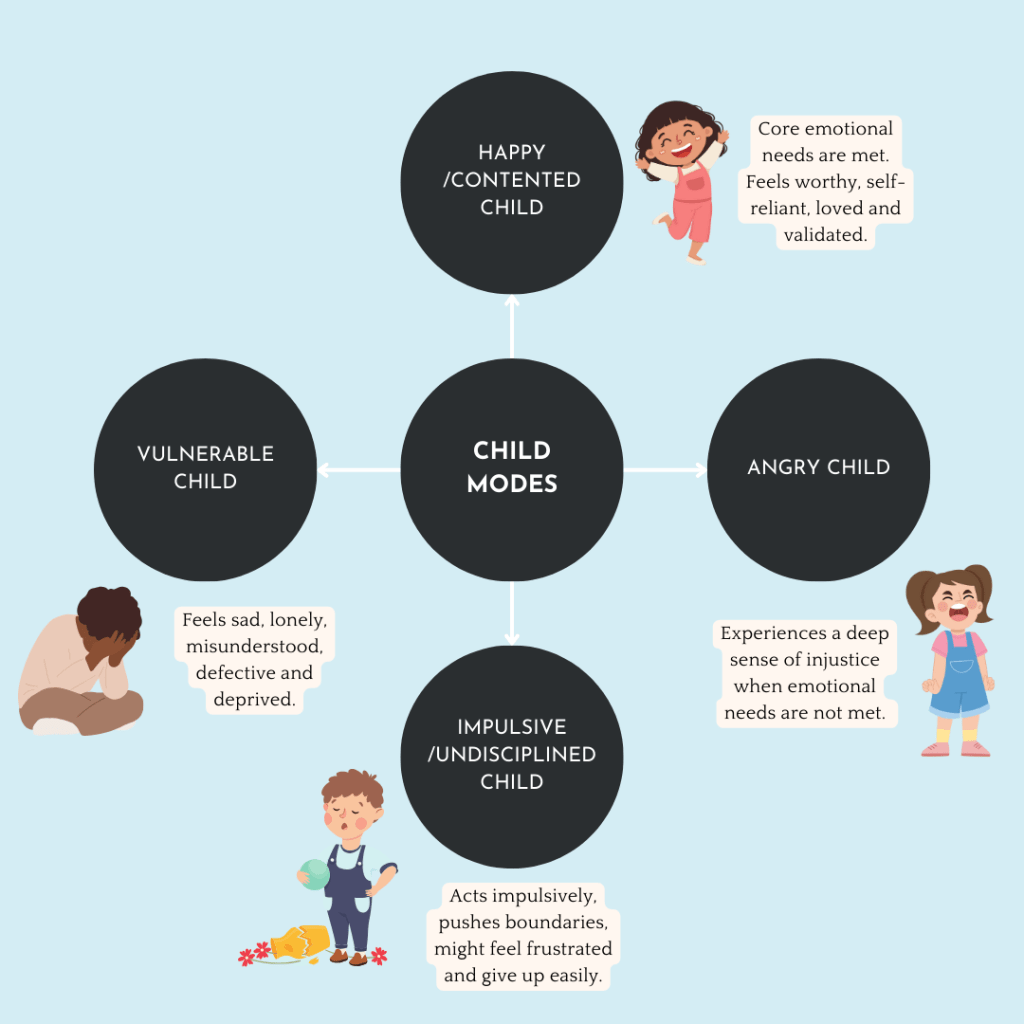
Child Modes
- Happy Child: “feels loved, contented, connected, satisfied, fulfilled, protected, accepted, praised, worthwhile, nurtured, guided, understood, validated, self-confident, competent, appropriately or self-reliant, safe, resilient, strong, in control, adaptable, included, optimistic, spontaneous”5.
- Angry Child: does not have their core emotional or physical needs met. Feels “intensely angry, enraged, infuriated, frustrated, impatient”5.
- Impulsive /Undisciplined Child: has difficulty postponing gratification, acts on impulses, often in a selfish way. When there is no possibility for instant gratification, often feels intensely “angry, enraged, infuriated, frustrated, impatient”5.
- Vulnerable Child: does not have their core emotional or physical needs met. Often “feels lonely, isolated, sad, misunderstood, unsupported, defective, deprived, overwhelmed, incompetent, doubts self, needy, helpless, hopeless, frightened, anxious, worried, victimized, worthless, unloved, unlovable, lost, directionless, fragile, weak, defeated, oppressed, powerless, left out, excluded, pessimistic”5.
Maladaptive Coping Modes
- Surrenderer (Compliant Surrender): gives in (surrenders) to their schemas6. Will act, think and feel in a way that maintains the dysfunctional patterns that derive from the maladaptive scheme. May act in a “passive, subservient, submissive, approval-seeking, or self-depreciating way”.5
- Avoidance (Detached Protector): finds ways to escape or block out schemas6. Mostly characterised by detachment, from own needs and feelings, people and activities. “Feels withdrawn, spacey, distracted, disconnected, depersonalised, empty or bored”5.
- Overcompensator: does the opposite of their schemas6. “Feels and behaves in an inordinately grandiose, aggressive, dominant, arrogant, haughty, condescending, devaluing, over controlled, controlling, rebellious, manipulative, exploitative, attention-seeking, or status-seeking way”5, as way to cope with (perhaps unconscious) unmet needs.

Maladaptive Parent Modes
- Good Parent Mode: instructive role model for the development of the Healthy Adult Mode. In Schema Mode Therapy, the therapist takes on the role of the Good Parent to coach the client on how to respond differently to challenging or distressing situations6.
- Punitive Parent: strictly reinforces rules and will blame, punished or abuse self or others5.
- Demanding Parent: expresses internalised strict, high standards and rules for achievement and perfection5.
- Guilt-Inducing Parent: variant of the punitive and demanding critic, using guilt inducing messages to set unrealistic expectations, criticise, shame and control7.

Healthy Adult Mode: “nurtures, validates and affirms the vulnerable child mode; sets limits for the angry and impulsive child modes; promotes and supports the healthy child mode; combats and eventually replaces the maladaptive coping modes; neutralizes or moderates the maladaptive parent modes”5.

A bit more about dysfunctional coping modes…
Coping modes or strategies are sets of behaviours or thoughts which are employed in stressful, unpleasant or threatening situations 1, 2. There are three maladaptive schema coping modes: surrender, avoidance and overcompensation.
The best way to explain them would be to imagine three different individuals: Sophie, Marco and Sara. All of them hold a schema of “Unrelenting Standards”. This schema is characterised by a lack of freedom in the expression of our own needs, preferences and emotions, and a high emphasis on achievement, self-control and perfection. Now let’s suppose that Sophie, Marco and Sara are all presented with the same triggering situation, the request to submit an important report for work, by the end of the month.
Sophie responds to this stressful trigger by using a surrender coping mode. She will yield to her “Unrelenting Standards” schema, instead of trying to fight it or avoid it. She will act in a way that confirms this schema, for instance by spending exaggerated amounts of time trying to perfect the report, until she becomes exhausted while ignoring her own needs.
Marco holds the same “Unrelenting Standards” schema. However, his response to being presented with the task of writing the report is avoidance. Avoidance is connected to the efforts employed in making sure that a schema is never activated, so individuals can live their lives as if the schema did not exist. Thoughts and images connected to the schema are repressed, intense emotions are pushed back and situations which may be triggering avoided. Marco procrastinates writing the report until the last possible minute and then becomes intensely agitated days before the deadline for submission.
Finally, Sara represents overcompensation. While she is driven by the same deep-rooted beliefs that move Sophie and Marco, she copes with the triggering situation by thinking, feeling, and behaving as though the opposite of it was true. She might act as if she did not care about the task at hand at all, she might do a careless job of it, not dedicating enough time or care. It is important to note that, while fighting back our schemas may be healthy, overcompensation takes it too far in a way that may bring extra negative consequences for one’s life and relationships.
1Young, J. E., Klosko, J. S., & Weishaar, M. E. (2006). Schema therapy: A practitioner’s guide. Guilford Press.
2American Psychological Association. (n.d.). APA dictionary of psychology. APA Dictionary of Psychology. https://dictionary.apa.org/
3Arlin Cuncic. (2022, May 17). Maladaptive behaviors can prevent you from adapting to daily life. Verywell Mind. https://www.verywellmind.com/what-is-the-meaning-of-maladaptive-3024600
4Schema modes. (n.d.). Introduction. https://www.schematherapy.com/id61.htm
5Schema mode listing. (n.d.). Introduction. https://www.schematherapy.com/id72.htm
6The Psych Collective. (2024). The good parent. Support for Mental Health | The Psych Collective. https://www.thepsychcollective.com/the-good-parent
7White, J. (2023, Summer). Relieving the Burden of the Guilt Inducing Critic. Schema Therapy Bulletin, (30).
Subscribe
Enter your email below to receive updates.
 Melim Psychology and Coaching
Leave a comment